
Table of Contents
Summarize and analyze this article with

Chat GPT

Perplexity

Grok

Google AI

Claude
Introduction
Since its commercial debut in 1997, WiFi has fundamentally changed how we communicate, work, and access information. Nearly three decades later, we’re witnessing another revolutionary shift as artificial intelligence transforms wireless networks from static systems into dynamic, self-optimizing platforms. In 2025, AI-driven network management is becoming essential for organizations seeking to enhance performance, strengthen security, and reduce operational costs.
The AI Revolution in WiFi Networks
Traditional WiFi networks operate on manually configured rules and static settings that require constant IT oversight. Modern AI-powered networks represent a paradigm shift—they learn, adapt, and optimize themselves in real-time based on actual usage patterns and environmental conditions. According to Cisco’s Global Networking Trends Report, 60% of IT leaders and professionals plan to leverage AI for predictive network automation within two years, signaling widespread industry adoption.
This transformation is particularly timely as WiFi 7, certified in early 2024, is designed to support over 19.5 billion connected devices globally, creating unprecedented demands on network infrastructure that only AI-driven solutions can effectively manage.
How AI Enhances WiFi Security
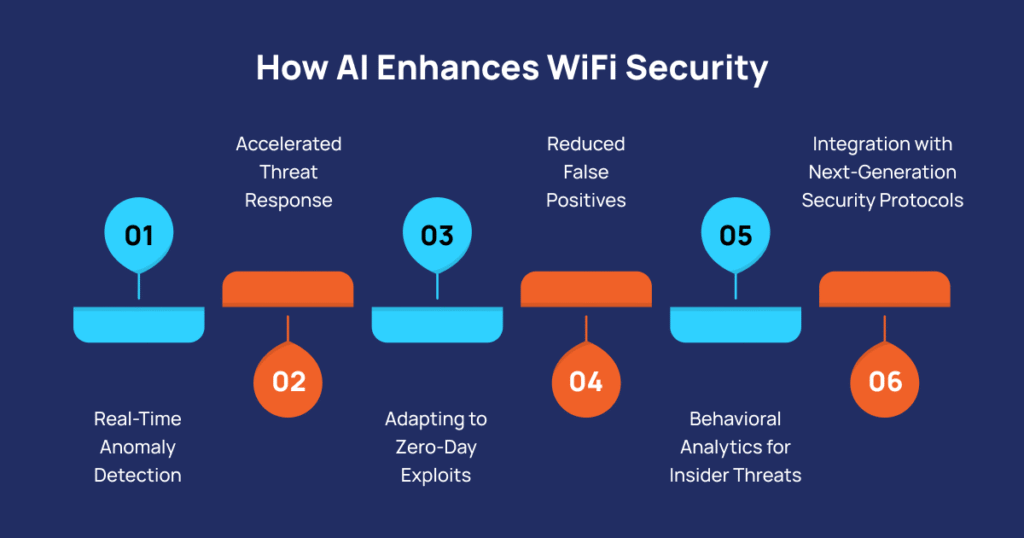
Cybersecurity threats are evolving faster than traditional defense mechanisms can adapt. AI provides a proactive, intelligent approach to network security that goes far beyond conventional firewall rules and signature-based threat detection.
Real-Time Anomaly Detection
AI systems establish baseline behavioral patterns by continuously analyzing network traffic across all connected devices. When unusual activity occurs—such as a device accessing sensitive files at irregular hours, transferring abnormally large data volumes, or exhibiting suspicious communication patterns—the system immediately flags it as a potential threat.
These machine learning models can detect and block potential threats in real-time by identifying anomalies in user behavior, network traffic, and data requests.
Accelerated Threat Response
Human security teams, no matter how skilled, cannot match AI’s ability to process massive datasets at machine speed. AI-powered security systems identify threats in milliseconds and can automatically respond by blocking malicious traffic, isolating compromised devices, or alerting administrators—all before significant damage occurs. According to Darktrace’s 2025 State of AI Cybersecurity report, 78% of Chief Information Security Officers have experienced positive impacts from AI in cybersecurity.
Adapting to Zero-Day Exploits
Traditional security systems struggle with unknown threats for which no signature exists. AI continuously learns from new attack patterns, enabling it to identify and defend against zero-day exploits and previously unknown vulnerabilities. This adaptive capability means your network becomes more secure over time, not just harder to breach.
Reduced False Positives
One of the most frustrating aspects of network security is alert fatigue from false positives. Machine learning algorithms become increasingly sophisticated at differentiating between legitimate unusual activity and genuine security threats, dramatically reducing false alarms and allowing IT teams to focus on real issues.
Behavioral Analytics for Insider Threats
AI monitors individual user and device behaviors to identify risky activities that might indicate compromised credentials, insider threats, or policy violations. This includes detecting unusual access patterns, data exfiltration attempts, or privilege escalation—threats that traditional perimeter defenses often miss.
Integration with Next-Generation Security Protocols
As of 2025, wireless security is evolving with enhanced WPA3 protocols, AI-driven defenses, and the development of quantum-resistant encryption. AI systems are being designed to work seamlessly with these advanced security standards, providing layered protection against both current and emerging threats.
How AI Optimizes Network Performance
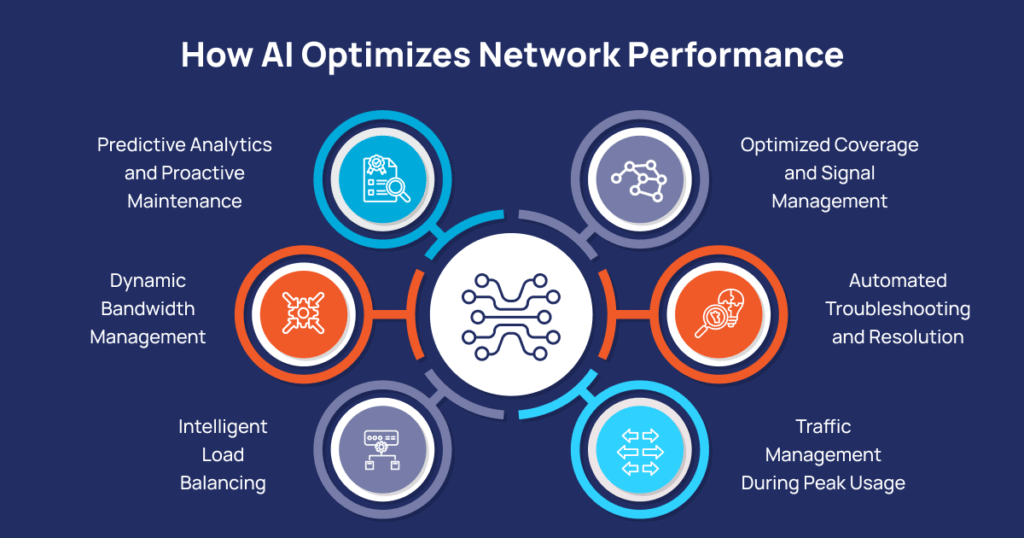
Beyond security, AI is revolutionizing network performance management by automating tasks that previously required extensive manual configuration and constant monitoring.
Predictive Analytics and Proactive Maintenance
AI-driven Proactive Network Maintenance (PNM) enhances network reliability by identifying and addressing issues before they impact customer service. By analyzing historical usage patterns alongside real-time conditions, AI systems can forecast network congestion, anticipate equipment failures, and proactively reroute traffic to prevent service disruptions.
Dynamic Bandwidth Management
AI-powered networks intelligently allocate bandwidth based on real-time device needs and application priorities. When someone joins a video conference or starts an online gaming session, the system automatically prioritizes their connection while temporarily reducing bandwidth to less critical activities like background software updates. This ensures optimal performance for high-priority tasks without manual quality-of-service configuration.
Intelligent Load Balancing
In environments with multiple access points, AI dynamically distributes connected devices to prevent any single access point from being overwhelmed. The system considers factors like signal strength, current device load, application requirements, and interference patterns to ensure every user experiences stable, high-performance connectivity.
Optimized Coverage and Signal Management
AI analyzes signal strength patterns throughout physical spaces to identify weak coverage zones and automatically adjusts access point settings to compensate. Advanced techniques like beamforming direct signals more precisely toward individual devices, reducing dead zones and improving overall network stability. Modern systems feature AI-enhanced Radio Resource Management (AI-RRM) for automated RF optimization and AI-native performance tuning.
Automated Troubleshooting and Resolution
AI-powered diagnostic systems can pinpoint the root causes of network issues—whether hardware failures, configuration problems, or interference sources—and often resolve them automatically without human intervention. This significantly reduces downtime and frees IT teams to focus on strategic initiatives rather than routine troubleshooting.
Traffic Management During Peak Usage
The industry is leveraging AI for smarter traffic management, improving efficiency and reducing latency during peak usage periods. This is particularly valuable in high-density environments like offices, universities, and public venues where network demands fluctuate dramatically throughout the day.
WiFi 7: The Platform for AI-Powered Connectivity
WiFi 7 boasts theoretical peak speeds of 46 Gbps—nearly five times faster than WiFi 6—with early real-world tests demonstrating actual download speeds exceeding 3.8 Gbps. But speed is only part of the story. WiFi 7’s advanced capabilities create the ideal platform for AI-driven network management:
- Multi-Link Operation (MLO):Devices can transmit and receive data across multiple frequency bands simultaneously, with AI intelligently selecting the optimal path based on real-time conditions
- 320 MHz Channels: Dramatically increased bandwidth supports data-intensive applications like 8K streaming, VR/AR experiences, and cloud-based AI processing
- Ultra-Low Latency: Reduced to millisecond levels, enabling real-time applications that were previously impractical over wireless connections
- Enhanced Device Density Support: Maintains stable connections even in crowded environments like stadiums, airports, and conference centers
According to IDC data, WiFi 7 made up approximately 5% of enterprise access point revenue in Q3 2024, with forecasts projecting growth to 10% of overall WiFi access point shipments in 2025.
The Future of AI in WiFi Networks
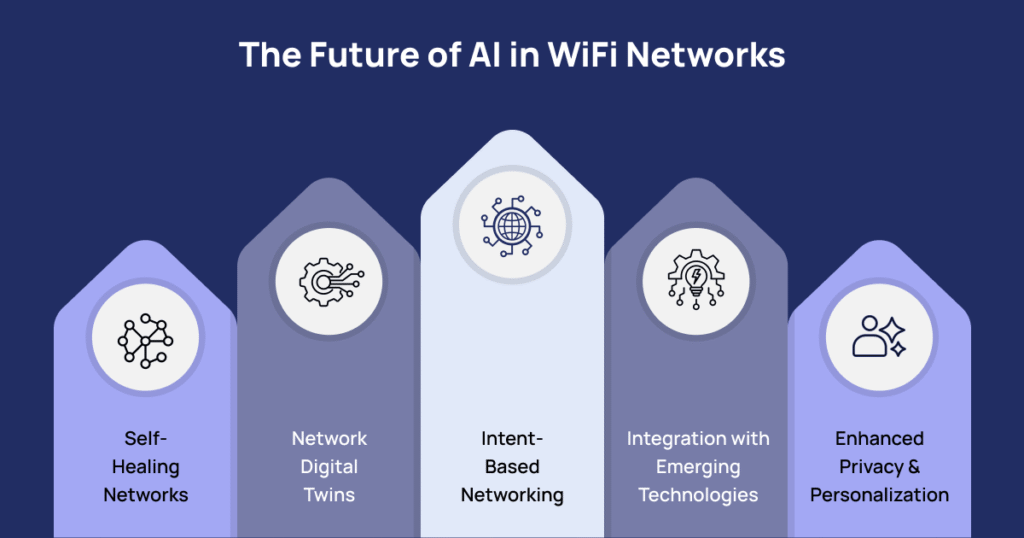
The convergence of AI and wireless networking is still in its early stages. Looking ahead to the next few years, we can expect even more transformative capabilities:
Self-Healing Networks
Future AI-powered networks will autonomously detect and resolve issues with minimal human oversight. When problems occur—whether hardware failures, configuration errors, or performance degradation—the network will diagnose the issue, implement solutions, and verify restoration automatically.
Network Digital Twins
Virtual replicas of physical networks will enable organizations to simulate different scenarios, test configuration changes, and optimize performance in a risk-free environment before implementing changes in production. These digital twins use AI to model network behavior under various conditions with remarkable accuracy.
Intent-Based Networking
Networks will increasingly configure themselves to achieve desired business outcomes automatically. Rather than specifying technical settings, administrators will define objectives—such as “ensure video conferences never experience lag” or “prioritize customer-facing applications”—and AI will translate these intentions into optimal network configurations.
Integration with Emerging Technologies
AI-driven cloud systems will intelligently manage data distribution, optimizing which data gets processed at the edge versus in the cloud to improve performance. This integration of AI, edge computing, and cloud platforms will create seamless, intelligent connectivity ecosystems.
Enhanced Privacy and Personalization
Future AI systems will provide dynamic, context-aware security that adapts based on user profiles, device types, and situational factors while maintaining rigorous privacy protections. This balance between security and user experience represents the next frontier in network management.
Contact PiTech for Expert Consultation
The integration of AI into WiFi networks represents more than an incremental improvement—it’s a fundamental transformation in how we design, secure, and manage wireless connectivity. As networks become more complex and cyber threats more sophisticated, AI-powered solutions transition from competitive advantage to operational necessity.
Whether you’re considering upgrading to WiFi 7, implementing AI-driven security, or optimizing your existing network infrastructure, PiTech’s experts can guide you through every step of the journey. Our team stays at the forefront of emerging technologies to ensure your organization benefits from the latest innovations in network management and security.

Key Takeaways
- AI transforms static WiFi networks into dynamic, self-optimizing systems that continuously learn and adapt to changing conditions
- Security benefits include real-time threat detection, faster response times, reduced false positives, and defense against zero-day exploits
- Performance improvements encompass predictive analytics, dynamic bandwidth management, intelligent load balancing, and automated troubleshooting
- WiFi 7 provides the high-speed, low-latency platform necessary for advanced AI-powered network management
- 78% of CISOs report positive impacts from AI in cybersecurity, with 60% of IT leaders planning AI adoption for network automation
- The future includes self-healing networks, digital twins, and intent-based configurations that further reduce IT complexity
Frequently Asked Questions (FAQs)
Will AI completely replace network administrators?
No. While AI can automate many routine tasks and even perform entire workflows autonomously, humans remain essential for oversight, decision-making, and addressing complex challenges. AI augments IT teams by handling repetitive work, allowing professionals to focus on strategic initiatives.
Is my current network compatible with AI-powered management?
Many AI networking solutions can work with existing infrastructure, though optimal performance typically requires modern access points and controllers. Consult with network specialists to assess your specific environment and determine the most cost-effective upgrade path.
How does AI-powered WiFi security compare to traditional security measures?
AI complements rather than replaces traditional security measures. Multi-factor authentication, robust encryption like WPA3, and solid cryptographic processes remain essential foundations that AI-driven approaches supplement with adaptive, real-time threat detection capabilities.
What's the ROI timeline for implementing AI-powered WiFi solutions?
Organizations typically see immediate benefits in reduced troubleshooting time and improved user experience. Long-term ROI comes from reduced downtime, enhanced security (avoiding costly breaches), optimized network performance, and lower operational costs as AI handles routine management tasks.
Should my organization wait for more mature AI networking solutions?
While AI networking continues evolving, current solutions deliver tangible benefits today. Given that WiFi access point hardware typically undergoes refresh cycles spanning five to seven years, deploying modern AI-capable infrastructure ensures organizations avoid repeated operational costs and minimizes the need for frequent upgrades.